The AI Economy Has Four Layers. Most People Are Only Watching One
Jul 26, 2026 · 5 min read
[this article was originally published on 15 March 2026, this is a re-upload]
Everyone is arguing about which AI model wins.
That's the wrong question.
The real power in the AI economy isn't in the models at all - and most people are looking in the wrong place.
Two weeks ago, Volkswagen licensed its autonomous driving AI from a Chinese startup called Xpeng.
Most people saw a car story. I see a diagram of how the entire tech industry is restructuring itself.
After 18 years building products across e-commerce, enterprise SaaS, and AI, I've been trying to make sense of what's actually happening beneath the hype.
Not which model is smarter. Not which startup raised the biggest round.
But how the AI economy will actually be structured - who owns what, where the power concentrates, and where most businesses will live.
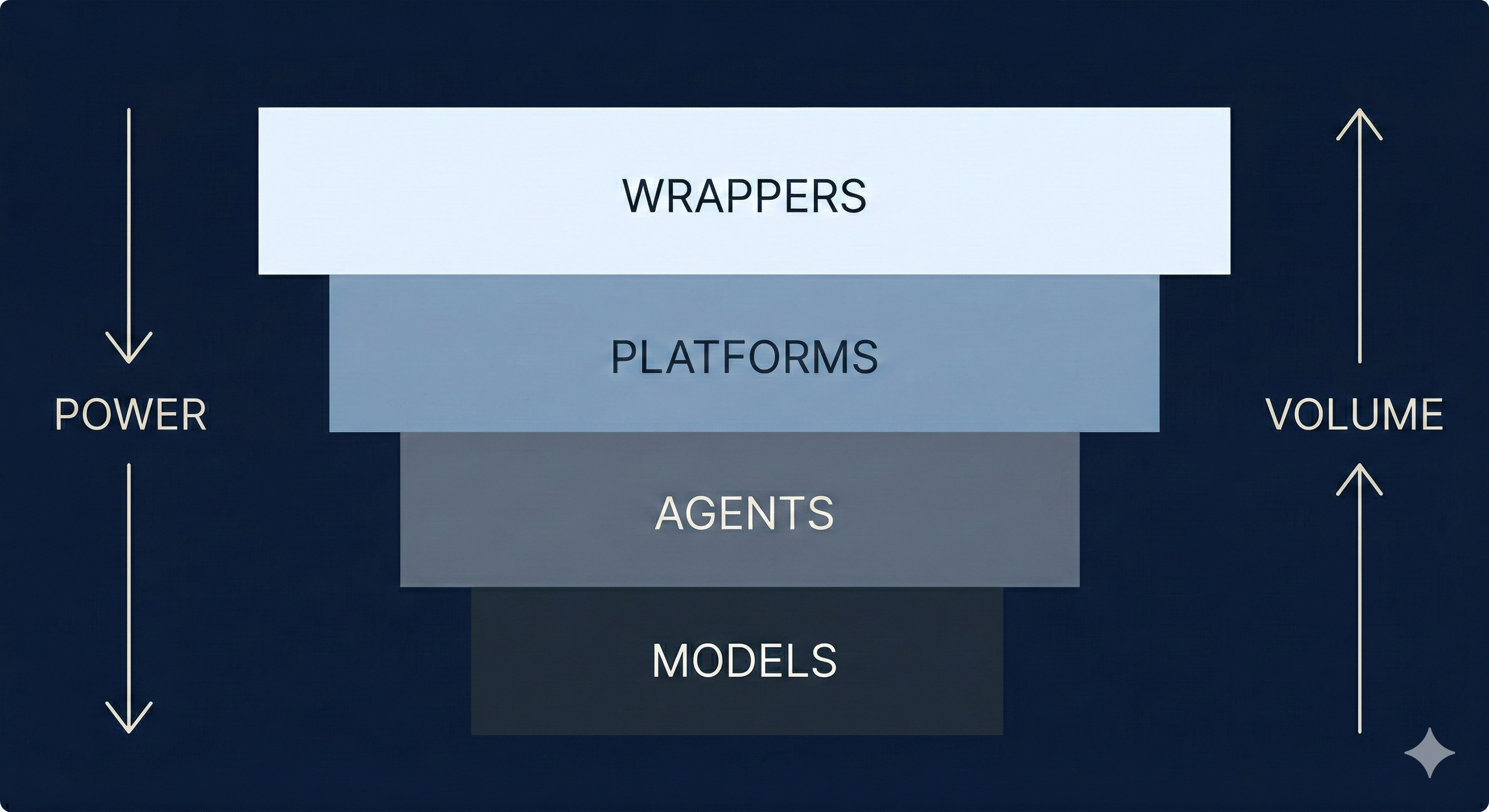
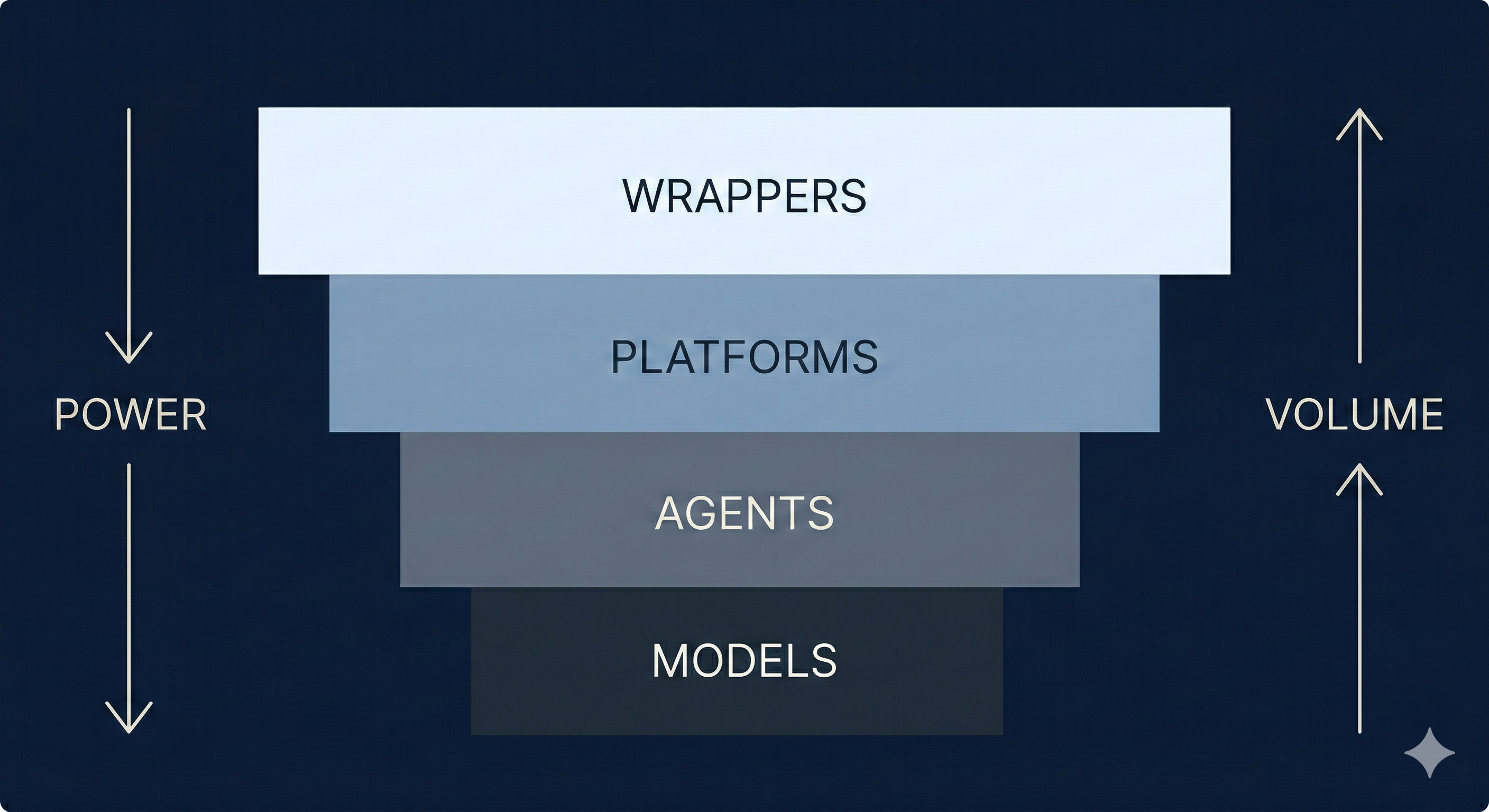
What I see is a four-layer stack.
Not exclusive categories - most significant companies will operate across multiple layers simultaneously. But understanding where a company's core defensibility lives changes everything about how you read the market.
Layer 1 — Models: The Foundation
The raw capability layer.
Frontier models like GPT and Claude. Specialized models like Xpeng's VLA 2.0, a Vision-Language-Action system trained on 100 million driving videos, now licensed to Volkswagen for use across their entire vehicle lineup.
Models perceive, reason, and generate. They don't pursue goals autonomously.
They get called, they don't decide when to act.
Very few companies will dominate here. The barriers are extraordinary: compute, data, research talent, and capital at a scale only a handful of organizations can sustain.
Winner-takes-few, not winner-takes-all. Because specialization creates room for multiple players; frontier generalists, and domain specialists like Xpeng owning physical AI.
Layer 2 — Agents: From Sidekick to Autonomous Driver
This is where the industry is shifting right now.
An agent accepts a goal, orchestrates models and tools to pursue it across multiple steps, and delivers a finished outcome, without human direction at each step.
Perplexity just launched "Computer"; a system that takes a high-level objective, spawns sub-agents to handle research, coding, and design in parallel, and delivers a complete result.
You come back to find the work done.
The same logic applies in the physical world.
A self-driving system that takes you from A to B; planning routes, adjusting for live traffic, handling charging stops along the way, is an agent. Same architecture, different environment.
Two worlds, one pattern: give it a goal, let it work.
Layer 3 — Platforms: The Most Underrated Layer
Here's what almost nobody is talking about.
Platforms are the execution environment, what gives agents something to act through.
Software platforms like Stripe and Salesforce. Infrastructure platforms like AWS. And physical platforms: vehicle architectures, factory production lines, warehouse automation systems, robotic bodies.
Physical platforms are where digital intelligence meets physical reality.
Xpeng's SEPA 2.0, the modular EV architecture that VLA 2.0 runs on top of, is the clearest example. Every kilometer driven on that platform generates training data that feeds back into better models. The data flywheel sits entirely within the platform owner's control.
You can't replicate a physical platform in a weekend.
That's why platform owners may ultimately be more defensible than frontier model companies.
Layer 4 — Wrappers: The Ocean
The customer-facing layer, the only place in this entire stack where end users and real experiences are directly visible.
Generic wrappers like Lovable serve savvy builders who want to create anything. Specialized wrappers serve a defined domain with deep contextual knowledge; a wellbeing platform, a legal tool, a supply chain assistant.
This layer will see faster and more brutal change cycles than any other.
Low barriers to entry. Near-zero switching costs. Constant pressure from improving models below, and model companies racing toward the customer above.
The SaaS businesses we've built careers around? Most of them are wrappers sitting on top of problems that are now solved differently.
When anyone can build bespoke software in hours, "good enough for everyone" becomes inferior to "perfect for me."
The interface dies.
The companies that survive are the ones that transform in time, turning their behavioral data and integrations into platform-layer assets before their interface becomes irrelevant.
Here's the counterintuitive conclusion.
Power concentrates at the foundation. Frontier model companies and physical platform owners will be more defensible than anything we saw in the internet era.
Value is captured at the surface. The vast ocean of wrapper businesses will generate most of the commercial activity, most of the jobs, and most of the direct customer relationships.
And the most overlooked battleground? The physical platform layer.
The companies building the bodies that agents act through; in vehicles, factories, warehouses, and robots, are building moats that no amount of model funding can easily replicate.
The VW-Xpeng deal wasn't a car story. It was a preview of how the AI economy settles.
This is the first in a series where I'll be exploring how AI restructures industries, business models, and the nature of work itself. Thoughts, challenges, and disagreements welcome, this framework is a work in progress.